As soon as trading enters the chat, brokers follow. You can not place an order in a market without some firm in the middle opening an account, holding your cash and sending trades to a venue. When you are debt-free, choosing a broker is mostly about costs, features and your style. When you are in debt, the picture changes.
The type of broker you use quietly pushes you toward certain behaviours. A high-leverage forex and CFD broker that flashes margin multipliers and one-click trading is nudging you toward short-term, aggressive bets. A stripped-down stockbroker that only lets you buy paid-up shares or broad ETFs with no margin is nudging you toward slow, simple investing.
If you have outstanding loans, cards or other obligations, those nudges matter more than people like to admit. Debt narrows your safety zone. You have fixed payments, interest that ticks every month, and less room to tolerate big swings in your account. The wrong broker type adds another layer of pressure right on top of that.
So the question “what type of financial broker is best when in debt” is really “what kind of platform is least likely to make your situation worse, and can still play a sensible role, if any, while you sort your balance sheet out”. The answer is not one single brand or logo. It is a set of features and limits that help you stay away from the kind of trading that keeps people stuck owing money.
What changes once you are in debt
Cash flow stress and risk tolerance
Debt changes how much risk you can sensibly take. Not in theory, on paper, but in your actual stomach.
A trader with no personal obligations can afford to let account equity swing up and down by twenty or thirty percent, as long as position sizing is sane and the system makes sense. It hurts, but bills still get paid. A trader with two maxed cards and a loan hanging over them does not have that luxury. Any serious drawdown is wired straight into real-life stress.
Fixed monthly payments and high interest eat into the spare cash you might have used as “risk capital”. That shrinks your ability to top up an account after a bad run, and makes every loss feel heavier. A trade that would have been annoying in a clean situation becomes a threat to your ability to pay rent, buy food or meet minimum repayments.
That is why your risk tolerance on a questionnaire is not the whole story. Debt pushes actual risk tolerance down, even if your personality says otherwise.
Time horizon and the “need to win fast” problem
Debt also distorts time horizons. Instead of thinking in years, you start thinking in weeks or even days. “If I can just make this much by the end of the month, I can clear that bill.” That short-term frame sits very badly next to markets that move on their own schedule.
The shorter your mental deadline, the more tempting aggressive trading becomes. You look for products that move fast and brokers that offer high margin, night and day trading, and flashy promotions. Those brokers exist because they know that clients under pressure generate a lot of volume, at least for a while.
A broker aimed at slow investing sends different signals. It pushes regular contributions, tax-efficient wrappers, long-term charts. No big promises about flipping an account this week. When you owe money, that background message matters. It either reinforces your sense of urgency or quietly tells you to calm down.
So before picking any broker, it helps to admit that debt reduces your financial padding and shortens your patience. The best broker for you right now is one that fights those two effects, or at least does not pour fuel on them.
Broker types that are a bad fit when you owe money
High-leverage FX and CFD brokers
Retail forex and CFD brokers are built around margin trading. The platforms are slick, spreads can be tight, and the marketing leans heavily on “control a larger position with a small deposit”. That is exactly what someone with limited capital and a desire to fix problems fast wants to hear.
You can learn more about how Forex and CFD trading work by visiting DayTrading.com. Daytrading.com have hundreds of articles on Forex trading and almost as many on CFD trading.
The problem is that the product is designed for frequent trading and uses margin as a core feature, not an optional extra. Your broker account shows available funds, used margin and free margin. Every trade invites the question “could I size this up a bit more”. Those numbers become another mental pressure gauge alongside your debt balances.
From the broker side, many firms act as market makers in contracts. They quote prices, take the other side, hedge some exposure and earn from spread markups and client losses over time. If you are in debt, you are basically paying a firm that benefits from your churn to give you a high-risk casino dressed as a platform.
Even when a forex or CFD broker uses more agency-like models such as STP or ECN, the problem stays. The default product set is short-term trading with built-in borrowing, not long term investing in real assets. That is a poor match for a person who already owes money.
Pure derivatives and short-term options brokers
Some brokers specialise in options, short-term contracts and structured bets on price moves. They might offer weekly or even daily options, turbo certificates, spread bets or in some regions binary-style payoffs.
These firms are not all shady. Many operate under serious regulation and disclose risks clearly. But the payoff profiles are harsh, especially when used as high-risk punts rather than part of hedged strategies. You can lose the entire premium very quickly. The psychological hit from a string of small, complete losses is large even when you are not in debt. When you are, it tends to trigger revenge trades and size jumps.
Brokers that live on this business also have to keep volume high. They depend on clients turning positions over and over. The educational material often focuses on how to find “opportunities” in every slight turn of the chart, which subtly pushes you toward over-trading.
Short-term derivatives are sharp tools. People who are already carrying obligations usually have better things to do than juggle sharp tools over a thin carpet.
Crypto-only trading platforms
Crypto exchanges and brokers sit on a sliding scale from relatively plain spot venues to wild futures and perpetual swap platforms with very high margin.
If you are in debt, the louder platforms are the worst fit. Twenty-four hour access, promotional emails, constant new coins, derivatives with funding rates and liquidations, social trading features with leaderboard snapshots. All those nudges line up with frustration and fear of missing out, not with patient debt reduction.
Even spot-only crypto brokers are a mixed bag here. Volatility in many coins is high, drawdowns can be large, and real-world economic use may be uncertain. Someone who has not yet dealt with expensive debt is effectively borrowing at one rate to gamble on digital assets with wide possible price paths. That math rarely comes out well unless you were going to hold for very long periods and accept big swings, which is hard to do if bank statements are already making you twitchy.
Crypto has a place for plenty of investors, but as a first stop while trying to climb out of debt, it is a rough start.
What “safer” means in broker terms – core principles
Cash accounts, no margin and plain products
For someone in debt, safer does not mean completely risk-free. There is still market risk in any investment. Here it mainly means “harder to blow yourself up in a weekend”.
That starts with the account type. A cash account, where you pay in full for assets and can not borrow to buy more, is a useful constraint. You can not wake up with a margin call. You can not be forced to liquidate because a small move tipped an over-geared position over the edge.
A broker that keeps margin as something you have to opt in to later, or hides it behind extra forms and checks, is preferable to one that hands it to every new account as the default. While you still carry expensive obligations, anything that slows you down before you can borrow against your portfolio is your friend.
Next are the products. Plain shares, broad ETFs, simple government or investment-grade bond funds are dull on purpose. They move, but not like small caps on memes or thin crypto tokens. A broker whose core menu is those instruments is less likely to tempt you with exotic contracts that promise a fast way out.
Regulation, custody and boring fee structures
Regulated brokers in major regions are required to separate client money, keep capital buffers and follow strict conduct rules. That does not guarantee perfection, but it removes some types of disaster from the table. If you are in debt, the last thing you need is broker failure on top of everything else.
Boring fees help too. You want clear commissions, clear FX markups and no hidden financing charges on positions because you are not using margin. Account fees and platform charges should be visible. Account types that pay a bit of interest on idle cash are nice but not the main point.
A broker that blasts out promotions, bonuses tied to volume or contests for “top trader of the month” is not thinking about your debt. A broker that quietly offers a simple menu, low ongoing costs and no flashy rewards for high turnover is much closer to what you need.
Stock and ETF brokers as the default choice
Simple cash equity brokers
For most people who insist on keeping some market exposure while paying down debt, a standard stock and ETF broker with a basic cash account is the least bad option.
You deposit money from income that is genuinely spare after mandatory expenses and planned repayments. You buy paid-up positions in shares or funds. You can not buy more than the cash available, and you can not short-sell. The platform supports limit and market orders, some basic charting, maybe some screeners, but nothing that screams “flip this three times today”.
This type of broker keeps trading behaviour closer to investing behaviour. You still make choices that can go wrong. You might still chase hot names now and then. But you are doing it with full payment, no borrowing against future you, and no auto-liquidation thresholds.
It is still wise to avoid day trading even here when you are in debt. The tool just makes that discipline easier because the product set is slower by design.
Low-cost index and ETF platforms
Some brokers revolve almost completely around ETFs and index funds. They may offer commission-free trading in certain funds, automatic monthly investment plans and tax wrappers where those exist.
For someone carrying debt, these platforms can help counter the urge to treat markets as a way to hit a home run. The default behaviour is periodic investing into broad exposure. You can still pick bad funds or chase sector themes too hard, but the gravitational pull is in favour of diversified, longer horizon positions.
Many of these brokers do not push margin heavily, or they restrict it to larger accounts with extra checks. That is another helpful brake. While you still have cards or loans charging double-digit interest, anything that nudges you toward buying broad funds with cash instead of borrowing for concentrated bets is useful.
When robo-style services can help
Robo-advisers and similar services sit between a DIY broker and a full financial planner. You answer a risk questionnaire, they suggest a mix of funds, and run rebalancing for you. Fees are usually lower than for human-advised accounts but higher than bare bones discount brokers.
For someone in debt, a robo service is not a magic fix. It does not solve the basic issue that you are investing while owing money. But it can remove some of the emotional noise that leads to frantic trading. The system allocates your contributions to a set plan, rather than letting you jump in and out of positions based on short-term fear and hope.
The catch is that fees, even small ones, still sit on top of your already negative carry from debt. If the robo fee is higher than what a simple low-cost ETF platform would charge, you should at least weigh whether the extra structure is worth it. The main win from robo in a debt context is behavioural: it stops you yanking money in and out based on the last headline.
Multi-asset brokers and how to use them carefully
Turning off the dangerous parts
Many modern brokers offer everything under one roof: shares, ETFs, FX, CFDs, crypto, options, maybe even futures through separate entities. That convenient menu can be great for a seasoned trader. For someone with debt, it is like putting both vegetables and high sugar snacks in the same cupboard and trying to pretend they all count as groceries.
If you like the idea of one login and one statement, you can still make this work, but you need to treat settings as guardrails. Most such brokers allow you to restrict certain modules. You can ask support to disable margin trading, CFD access or options permissions. You can avoid applying for professional account status that would increase your risk limits.
On your side, you can ignore the parts of the platform that point toward news-driven, short-term gaming. Hide tabs, remove watchlists that tempt you into small caps or thin coins, and stick to a simple short list of long-term instruments. It sounds almost childish, but friction is your friend here.
Using one account for both debt reduction and investing
There is also a practical angle. Some people in debt still want a modest investing habit so they do not feel they are “losing time” in markets while they pay loans down. You can reflect that by splitting inside one broker account.
One way is to treat a portion of each month’s surplus for investing and a portion for debt. For example, you put a small sum into a broad ETF each month through a simple broker, while the larger chunk goes straight to reducing the most expensive card. The broker is not there to fix the debt. It is there so that by the time the debt is gone, you already built the habit and a small base.
The key is honesty about size. If investing through a multi-asset broker slows the speed at which you clear expensive obligations by a lot, the math is off. In that case, a pause on investing and a stronger focus on repayment might be smarter, with the broker account dormant or funded at a token level just so you keep the process familiar.
How your debt profile changes the “best broker” answer
High-interest consumer debt
If most of your debt sits on high-rate cards, payday lenders or nasty store finance, the best “broker” in your life is probably a spreadsheet and a payment plan, not a trading platform. Every dollar you use to buy assets while paying twenty percent or more on outstanding balances has to work very hard just to break even in real terms.
In that situation, a broker still has a role, but it should be small at first. A basic stock or ETF broker with no margin and very low account fees is enough. You might send a tiny fraction of income to that account, just to build the habit and keep you feeling connected to markets, while the bulk goes to killing those expensive balances.
Using an FX, CFD or crypto broker as your main outlet when you have that kind of debt is asking to stay in the red much longer. The expected return on paying down the card is high and guaranteed. The expected return on a random short-term trading approach is the opposite.
Low-rate or long-term debt
If your only debt is a cheap mortgage, a sensible student loan or similar, the picture softens. Those balances are more like a background condition of modern life than an emergency. Many investors build portfolios and trade while carrying that kind of obligation.
Here, the “best broker” answer moves closer to what it would be for a debt-free person, with some caution. A normal stock and ETF broker, possibly with some bond and cash products, will serve most people. You might still avoid high-risk FX and CFD outfits and the louder crypto venues, but the urgency is lower.
You can justify more active strategies, careful option use or even modest futures trading if your skills, capital and temperament support it. The key difference is that a bad trading year is annoying, not life-changing. You are not trying to use markets as a rescue ladder from a burning building, more as a way to build net worth over time while servicing manageable obligations.
In short, the more painful and expensive your debt, the more boring and plain your broker should be.
Putting it together without kidding yourself
A broker is a tool, not a hero. The right type will not rescue you from debt on its own, and the wrong type can not force you to press buy. But structure pushes behaviour. The platform you choose shapes what “normal” looks like when you log in.
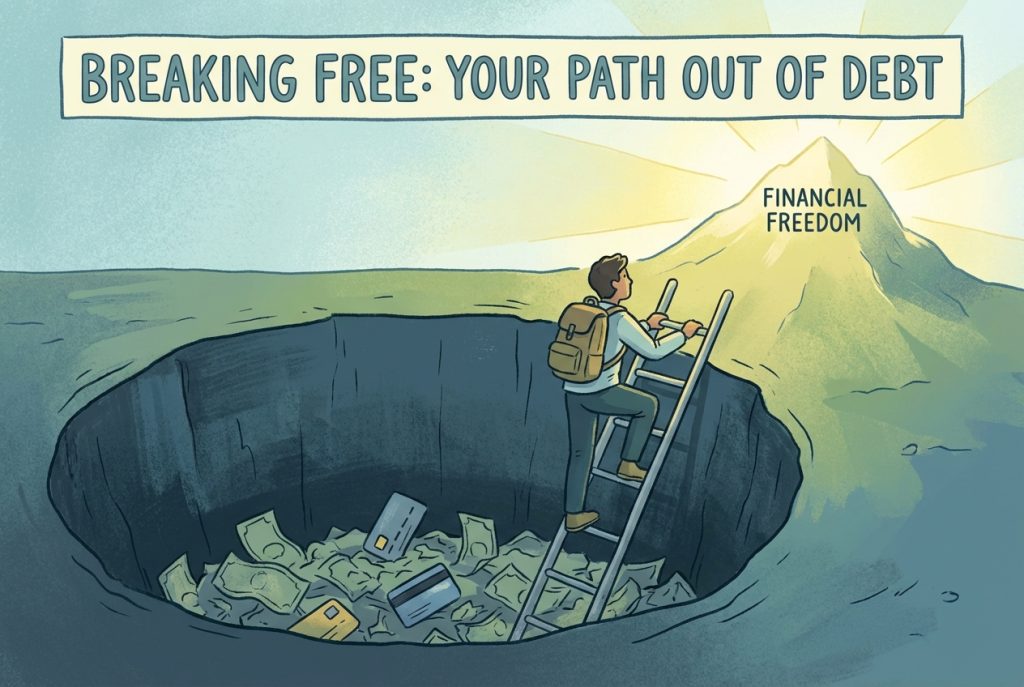
If you are already in a hole, the best broker is one that resists your worst impulses. That usually means a regulated stock and ETF broker, cash accounts only, plenty of friction before any borrowing, a limited menu of plain instruments, and no hype around frequent trading or huge short-term returns.
That is not glamorous, and it will not make good advertisement headlines. It does, however, match the reality of trying to rebuild a balance sheet. Fast trading loves volatility and bigger swings. Debt hates both. Until that conflict is resolved, let your broker be boring. Save the exciting stories for later, when you can afford to treat markets as a place to grow capital, not as a last-minute fix for problems that started somewhere else.